

Namaa NFF and Arab Programmers Co. Launch Joint Research Initiative in Computational Aroma Chemistry
Namaa Flavors & Fragrances (NFF) and Arab Programmers Co. (APC) have begun a joint research initiative in Computational Aroma Chemistry, exploring how computational chemistry, artificial intelligence, molecular machine learning and emerging quantum-computing methods can contribute to the scientific understanding of aroma molecules and fragrance ingredients.
The initiative brings together Namaa NFF’s industrial experience in fragrance development, aroma ingredients, essential oils and analytical evaluation with APC’s experience in software engineering, artificial intelligence and advanced computing.
Based in Egypt, the initiative can draw on the country’s aromatic and medicinal plant resources and natural aromatic materials, providing a practical foundation for connecting real molecules and analytical characterization with computational studies and experimental validation. The research maintains a broader scientific scope across aroma molecules and fragrance ingredients..
Where can advanced computational methods add measurable and reproducible value beyond established approaches in understanding aroma molecules and fragrance ingredients?
The research is designed to investigate that question through comparison, benchmarking, experimentation and evidence.
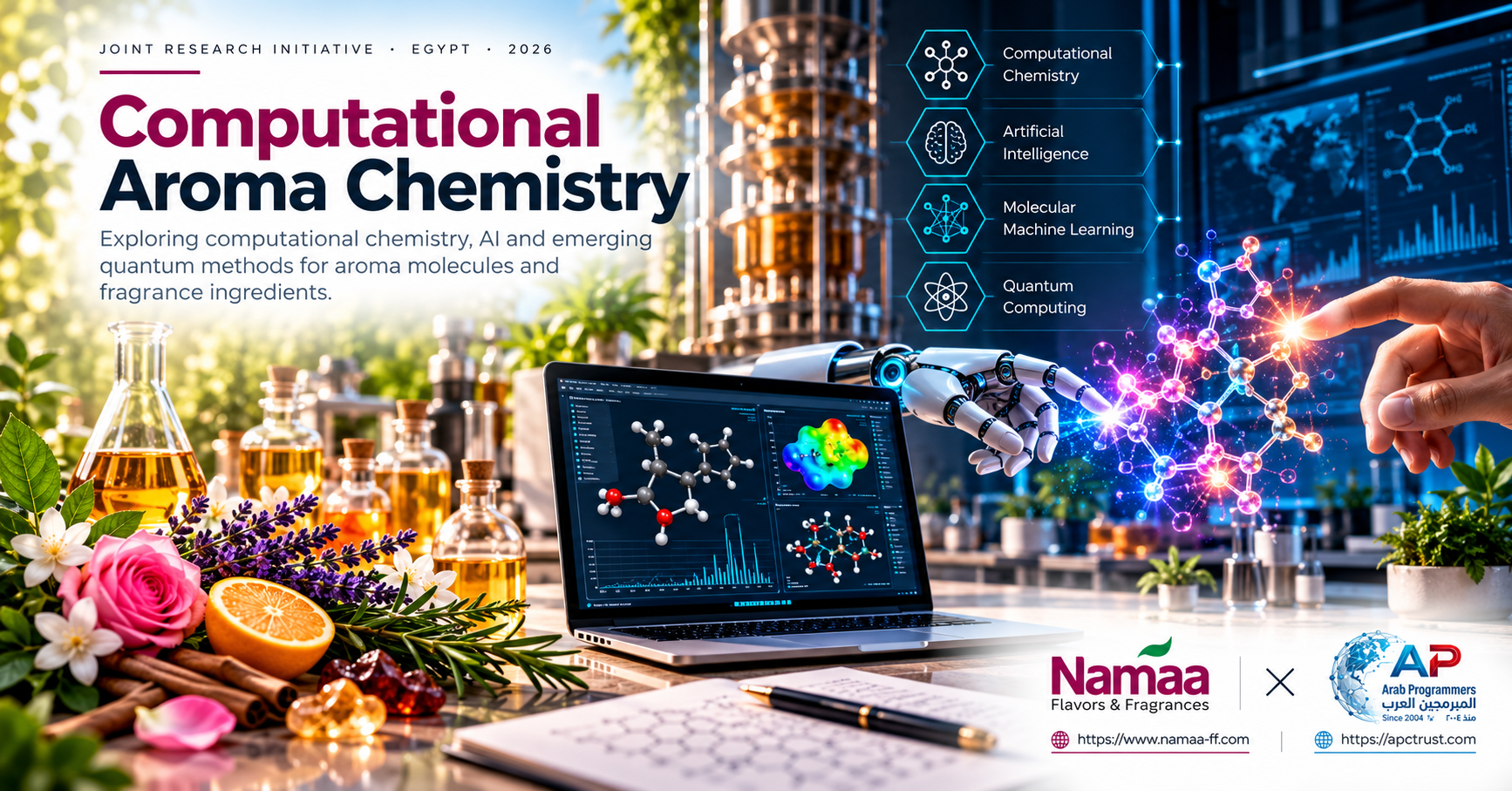
Research at a Glance
From Natural Aroma Materials to Molecular Understanding
Fragrance begins at the molecular level, yet the relationship between molecular structure, material properties and human odor perception remains highly complex.
Alongside its ongoing Natural Aroma Isolation development project, Namaa NFF is developing capabilities for the separation, isolation and characterization of valuable aroma compounds from natural aromatic materials.
Computational Aroma Chemistry extends this scientific direction from the physical and analytical study of aroma compounds toward their computational investigation.
This creates complementary research paths: from natural aromatic materials to isolated and characterized molecules, and from molecular data to deeper computational understanding.
The broader research scope is not limited to natural isolates. Selected aroma molecules and fragrance ingredients may be investigated wherever they provide scientifically meaningful questions and appropriate experimental or analytical benchmarks.
An Integrated Research Architecture
The initiative is being developed around a structured pathway connecting real aroma materials and molecular data with computational investigation and experimental evidence.
This architecture is intended to keep emerging computational technologies connected to measurable scientific questions rather than treating them as isolated technologies. The methods are compared where appropriate for each research problem.
Evidence Before Technology
Computational chemistry and AI already provide increasingly powerful methods for molecular research. Quantum computing introduces another emerging set of possibilities, particularly for selected molecular, electronic-structure and optimization problems.
Within this initiative, quantum or hybrid quantum-classical approaches will be investigated where the scientific problem makes their use appropriate and where meaningful comparison can be established.
Quantum advantage is treated as a research question to be tested, not an assumption.
The objective is to determine which computational approach adds the greatest scientific value to a particular problem, and why.
Beyond Odor Prediction
Predicting odor characteristics from molecular structure is an important area of computational olfaction, but it represents only part of the broader research opportunity.
The initiative may investigate selected aroma molecules across multiple computational layers, including molecular properties, three-dimensional behaviour, structure–property relationships, analytical and experimental data, molecular machine learning and scientifically appropriate quantum or hybrid approaches.
- Can established computational chemistry reproduce properties relevant to selected aroma molecules?
- Can AI identify useful relationships between molecular, calculated, analytical and experimental data?
- Which aroma-chemistry problems are appropriate candidates for quantum or hybrid quantum-classical investigation?
- Can different computational approaches provide complementary or improved information for specific, measurable problems?
- Can computational predictions be meaningfully connected with analytical, experimental or sensory evidence?
The longer-term scientific question is whether these layers can form a reproducible computational and experimental framework for aroma-ingredient research.
Potential Industrial Relevance
If scientifically validated, the research may contribute to more informed molecular screening, ingredient selection and prioritization, deeper understanding of structure–property relationships, and computational support for natural-isolate characterization and fragrance research.
Molecular Understanding
Investigating molecular properties and structure–property relationships relevant to aroma ingredients.
Ingredient Research
Exploring computational support for molecular screening, candidate prioritization and informed ingredient selection.
Experimental Efficiency
Investigating whether validated computational tools can help focus experimental research on scientifically relevant candidates.
These possibilities connect fundamental molecular research with practical aroma-ingredient development while preserving the essential role of chemical analysis, experimentation and sensory evaluation.
Two Fields. One Research Direction.
Namaa Flavors & Fragrances
Fragrance-industry expertise, aroma chemistry, aroma ingredients, essential oils and industrial and experimental research.
Visit Namaa NFF ↗Arab Programmers Co.
Software engineering, artificial intelligence, computational methodologies and advanced-computing research.
Visit Arab Programmers Co. ↗The purpose is to investigate how computation can provide additional scientific tools for chemists, researchers and fragrance specialists — and how those tools can be evaluated against real evidence.
Current Research Status
The initiative is currently in its research design and benchmarking phase, including the definition of suitable scientific questions, molecular candidates, computational methodologies, baseline methods and routes for experimental comparison.
As evidence develops, subsequent stages may include deeper computational studies, experimental validation, academic research collaboration and scientific publication.
Research findings will be communicated as they become scientifically supported.
Test what emerging technology can add.
Measure the difference.
Let the evidence define the next step.
This principle guides the joint research direction of Namaa NFF and Arab Programmers Co.
Scientific Context
The initiative builds upon continuing international research across computational olfaction, molecular machine learning, computational chemistry and quantum computing.
Developments across these fields include AI-based investigation of molecular odor characteristics, olfactory-receptor modelling, computational fragrance formulation, molecular simulation, quantum and quantum-inspired optimization, and hybrid quantum-classical approaches to molecular science.
These developments form part of the scientific foundation from which the initiative intends to investigate further questions relevant to aroma molecules and fragrance ingredients.
